
France is a country that has left an indelible mark on the world, its influence extending far beyond its borders through its rich cultural heritage. From the works of great French authors like Victor Hugo and Gustave Flaubert to the masterpieces of Claude Monet and Pierre-Auguste Renoir, France’s literature and art have captivated audiences for centuries. The country’s vibrant music scene has given us the likes of Édith Piaf and Charles Aznavour, while its cuisine has introduced the world to the joys of escargots, croissants, and Coq au Vin. But what is it about French culture that has made it so universally beloved? In this article, we’ll explore the history and development of France’s language, literature, art, music, and cuisine – the very building blocks of its civilization – and examine how these elements have contributed to its enduring global influence. By the end of this journey through the heart of French culture, you will understand the significance of la francophonie and be able to appreciate the rich heritage that France has shared with the world.
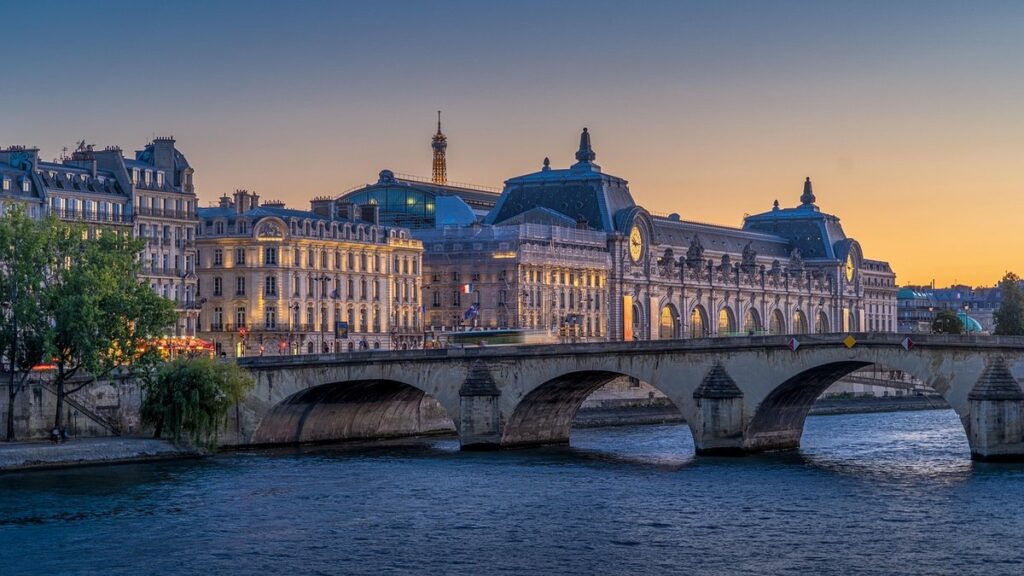
L’Histoire de la Langue Française
The history of French language is a rich and complex one, shaped by centuries of cultural exchange and linguistic evolution. We’ll take you on a journey through its development from Latin roots to modern-day nuances.
Origines Latines
The French language owes a significant debt to Latin, which has left an indelible mark on its grammar and vocabulary. When the Roman Empire conquered Gaul (modern-day France) in the 1st century BCE, Latin became the dominant language of the region. As a result, many Latin words entered the French lexicon, particularly in fields such as law, medicine, and architecture.
The influence of Latin can be seen in French grammar, particularly in the use of verb conjugations and noun declensions. For example, the French verb “finir” (to finish) follows the same pattern as its Latin counterpart “finire,” with the infinitive form ending in “-re.” Similarly, many French nouns follow the same declension patterns as their Latin equivalents.
French vocabulary is also replete with Latin loanwords. Estimates suggest that over 30% of modern French words have Latin origins. Examples include “château” (from Latin “castrum”), “gouvernement” (from Latin “gubernare”), and “société” (from Latin “socius”). Understanding the Latin roots of these words can help French learners decipher their meanings and improve their language skills.
Moyen Âge et Renaissance
During the Middle Ages, French underwent significant changes as it adapted to the needs of a growing and complex society. As the language spread throughout the Frankish kingdom, regional dialects began to emerge, influenced by local customs, geography, and culture. The Norman Conquest of England in 1066 introduced Anglo-Norman, a blend of French and Latin that would eventually shape English.
The Renaissance saw a resurgence in interest in classical languages and literature, leading to increased borrowing from Latin and Greek. This linguistic evolution contributed to the emergence of modern French, as regional dialects converged towards a standardized form. The establishment of the Académie française in 1635 marked an important step towards codifying the language.
As a result of these transformations, medieval French was characterized by its own distinct grammar, vocabulary, and pronunciation. Regional accents and dialects persisted, however, contributing to the rich tapestry of French linguistic diversity. Understanding this historical context can help appreciate the complexities of modern French, with its nuanced variations in regional dialects and standardized forms.
Les Époques Classiques et Romantique
During les Époques Classiques (17e siècle) and Romantique (19e siècle), French literature and poetry underwent significant transformations that impacted the development of the language. Writers like Molière and Racine pioneered a more refined, expressive style, which influenced the emerging language. Their use of complex syntax, nuanced vocabulary, and attention to poetic form raised the bar for literary expression.
The Romantique movement, led by poets such as Victor Hugo and Alfred de Musset, emphasized emotion, individuality, and the beauty of nature. This focus on subjective experience and the personal led to the creation of new words, idioms, and expressions that captured the essence of romantic sentimentality. The influx of new vocabulary not only enriched the French language but also reflected the changing values and tastes of the time.
The interplay between literature and language during these periods was reciprocal: writers responded to linguistic developments, while their own work contributed to shaping the language’s future trajectory. Understanding this dynamic can help readers appreciate the evolution of French as a living, breathing entity that has been shaped by artistic expression.
La Culture Populaire en France
La culture populaire française est une réalité fascinante qui reflète les valeurs et les traditions du pays, de la musique au cinema. Elle joue un rôle important dans l’identité nationale française.
Musique et Danse
France’s rich cultural heritage is reflected in its diverse musical and dance traditions. From classical music to contemporary styles like hip-hop, the country has a unique ability to evolve while maintaining its core identity. One of the most iconic aspects of French culture is its classical music scene, with renowned composers like Claude Debussy and Maurice Ravel contributing to the country’s rich musical heritage.
However, France is not just about traditional classical music; it also boasts a thriving contemporary music scene. Genres like jazz and rock have had a significant impact on the country’s musical landscape. In recent years, French hip-hop has gained popularity worldwide, with artists like NTM and IAM helping to spread the genre globally. This diversity in music is reflected in France’s vibrant dance culture, which encompasses everything from ballet to street dancing.
The intersection of music and dance can be seen in various festivals held throughout the country. For example, the Avignon Festival features a range of performances that blend music, dance, and theater. Similarly, the Nuits Sonores festival in Lyon celebrates electronic music and contemporary dance. These events showcase France’s ability to innovate while staying true to its cultural roots.
Cuisine Française
French cuisine is renowned for its rich flavors, intricate preparations, and exquisite presentation. At the heart of French cooking lies a deep respect for technique, with an emphasis on mastering fundamental skills such as sauce making, roasting, and braising. Haute cuisine, the epitome of French fine dining, showcases elaborate dishes like Coq au Vin and Bouillabaisse, which are often served in ornate restaurants.
Regional specialties also play a significant role in defining French cuisine. The Normandy region is famous for its creamy sauces and delicate fish dishes, while Provence is celebrated for its vibrant vegetable-based recipes and fragrant herb-infused oils. In the south, you’ll find hearty stews like Cassoulet, made with white beans and slow-cooked meats.
To experience authentic French cuisine at home, focus on using high-quality ingredients, such as fresh butter, farm-fresh eggs, and rich cheeses. Invest in a good stockpot for making flavorful stocks and sauces. Experiment with classic techniques, like reducing sauces to concentrate flavors or slow-cooking meat to tender perfection. By mastering these fundamental skills and embracing regional specialties, you’ll be well on your way to creating delicious French-inspired dishes that transport the senses to the heart of France.
Théâtre et Cinéma
French theater and cinema have a rich history that spans centuries. From the Comédie-Française to the avant-garde movements of the 20th century, French theater has been known for its elaborate productions and nuanced performances. The works of Molière, often considered the father of modern comedy, continue to be performed today. His plays like “Tartuffe” and “The Misanthrope” are still widely studied in schools and appreciated by audiences.
In cinema, the French New Wave movement of the 1960s revolutionized filmmaking with its innovative techniques and themes. Directors like Jean-Luc Godard and François Truffaut pushed boundaries with their gritty, realistic portrayals of everyday life. Their influence can be seen in films like “Breathless” and “Jules and Jim,” which explored themes of youth culture and social change.
French cinema has continued to evolve, incorporating new styles and genres while maintaining its unique aesthetic. From the romantic comedies of Éric Rohmer to the dystopian sci-fi of Jean-Pierre Jeunet, French filmmakers have made significant contributions to world cinema.
La Philosophie et la Littérature Française
Bien sûr, la philosophie et la littérature française ont toujours joué un rôle clé dans la formation de l’identité culturelle du pays. Nous allons explorer les liens étroits qui existent entre ces deux domaines artistiques.
Les Penseurs et les Écrivains
French philosophy and literature are deeply intertwined, with many of the country’s most influential thinkers also being accomplished writers. René Descartes, for example, is widely regarded as the father of modern Western philosophy, but he was also a skilled writer who produced several influential works on metaphysics and epistemology. Similarly, Jean-Jacques Rousseau and Voltaire were not only prominent philosophers but also prolific authors, with Rousseau’s “Discours sur l’Inégalité” (Discourse on Inequality) being a seminal work in the history of social contract theory.
On the literary side, Victor Hugo and Gustave Flaubert are two of France’s most celebrated writers. Hugo’s novels, such as “Les Misérables,” are famous for their sweeping narratives and memorable characters, while Flaubert’s “Madame Bovary” is a pioneering work of realist fiction that explores the complexities of provincial French life. These figures, among others, have helped shape the country’s literary landscape and continue to be widely studied and admired around the world today.
L’Impressionnisme et le Symbolisme
L’Impressionnisme se manifeste par une fascination pour les détails de la vie quotidienne et l’évocation des sensations provoquées par la lumière. Les écrivains impressionnistes, tels que Émile Zola et Alphonse Daudet, se concentrent sur l’expérience individuelle, en mettant souvent en scène les personnages dans des environnements réels. Leur écriture est caractérisée par une attention aux nuances de la réalité, à la fois visuelle et émotionnelle.
Le Symbolisme, quant à lui, se distingue par sa recherche d’une signification profonde derrière les apparences. Les écrivains symbolistes, tels que Stéphane Mallarmé et Paul Verlaine, s’intéressent aux aspects cachés de la vie, aux mythes et aux légendes. Leurs poèmes sont souvent des méditations sur l’essence de l’être humain et de la condition existentielle.
Ces deux mouvements littéraires se rejoignent en partageant une réflexion sur les aspects subjectifs de l’expérience humaine. Cependant, alors que l’Impressionnisme met l’accent sur le monde visible, le Symbolisme explore le monde intérieur et les dimensions spirituelles.
Les Écrivains du XXe Siècle
Simone de Beauvoir, Jean-Paul Sartre, et Samuel Beckett sont considérés comme des figures clés de la littérature française du XXe siècle. Leur travail a marqué un tournant important dans l’écriture française en abordant des thèmes existentiels et philosophiques qui étaient alors peu explorés.
Simone de Beauvoir, par exemple, est connue pour son livre « Le Deuxième Sexe », une analyse féministe qui remet en question les normes sociales traditionnelles. Son écriture s’inscrit dans le mouvement existentiel, qui met l’accent sur la liberté individuelle et la responsabilité.
Jean-Paul Sartre, quant à lui, est célèbre pour ses romans « La Nausée » et « Huis Clos », qui dépeignent la condition humaine dans une perspective existentielle. Ses écrits abordent des thèmes tels que l’angoisse, la liberté et la responsabilité.
Samuel Beckett, quant à lui, est connu pour ses pièces de théâtre « En attendant Godot » et « Fin de partie ». Son style d’écriture est caractérisé par une complexité linguistique et une exploration des thèmes existentiels. Les trois écrivains partagent un intérêt commun pour l’exploration des aspects fondamentaux de la condition humaine.
Ces auteurs ont contribué à façonner la littérature française du XXe siècle, en abordant des thèmes philosophiques et existentiels qui demeurent pertinents aujourd’hui.
La Civilisation Française
Bien sûr, maintenant que vous avez compris l’essence de la culture française, voyons ensemble ce qui fait la richesse de notre civilisation, depuis ses fondements historiques jusqu’à son expression artistique.
Architecture et Urbanisme
French architecture is a testament to its rich history and cultural heritage. From the soaring Gothic cathedrals of the Middle Ages to the sleek modern skyscrapers of today, each era has left an indelible mark on the country’s urban landscape.
One of the most iconic examples of medieval architecture is Notre-Dame de Paris, with its intricate stone carvings and imposing rose windows. In contrast, the Palace of Versailles is a masterpiece of 17th-century French Baroque style, featuring opulent decorations and carefully manicured gardens.
In the 19th century, Haussmann’s urban renewal project transformed Paris into a modern metropolis, with wide boulevards and grand squares that still define the city’s character today. More recently, architects like Jean Nouvel have pushed the boundaries of contemporary design, incorporating cutting-edge materials and innovative shapes into buildings like the Louvre Abu Dhabi.
French cities also boast numerous public spaces that are as much works of art as they are functional areas for socializing. The Luxembourg Gardens in Paris, for instance, offer a tranquil escape from the city’s hustle and bustle with its beautiful fountains, statues, and lush greenery.
Art et Design
French art and design have long been renowned for their unique blend of innovation and elegance. In the late 19th and early 20th centuries, a series of revolutionary artistic movements emerged from France, each contributing to the country’s rich cultural heritage. Impressionism, pioneered by Claude Monet and Pierre-Auguste Renoir, introduced a new way of capturing light and color on canvas.
Fauvism, led by André Derain and Henri Matisse, followed suit with its bold, vibrant use of color and energetic brushstrokes. Cubism, pioneered by Pablo Picasso and Georges Braque, further disrupted traditional representation with its geometric forms and multiple perspectives. These movements not only transformed the art world but also left an indelible mark on French design.
The influence of these artistic innovations can be seen in various aspects of French culture, from fashion to interior design. For instance, the iconic Art Nouveau style, characterized by sinuous lines and organic motifs, continues to inspire designers today. To appreciate France’s rich artistic legacy, consider visiting museums like the Musée d’Orsay or the Centre Pompidou, which showcase an impressive collection of Impressionist, Fauvist, and Cubist masterpieces.
By embracing these artistic movements, you can gain a deeper understanding of French culture and its enduring impact on the world.
Le Patrimoine Culturel
Cultural heritage plays a vital role in French identity and is deeply ingrained in the country’s consciousness. France is home to numerous historical sites, monuments, and museums that preserve its rich past. The preservation of these sites is crucial, not only for their aesthetic value but also as testaments to the nation’s history and cultural significance.
Traditional crafts such as tapestry-making, woodworking, and ceramics are also carefully preserved and promoted in France. Many artisans continue to practice these ancient techniques, passing them down to future generations. Visitors can experience these crafts firsthand by attending workshops or visiting designated artisanal centers.
The French government has implemented various initiatives to protect and promote cultural heritage. For instance, the country’s historical sites are classified according to their importance, with some receiving special protection under the “Monuments Historiques” designation. Additionally, many museums offer free admission on certain days of the week or month, making it easier for locals and tourists alike to explore and appreciate France’s rich cultural heritage.
These efforts not only help preserve but also promote French culture abroad, as visitors from around the world come to experience its beauty and significance firsthand.
L’Influence de la Culture Française à l’Etranger
La culture française a traversé les frontières et s’est implantée dans de nombreux pays, influençant les traditions et les modes de vie locaux. Ainsi, nous allons explorer ses effets en dehors des frontières françaises.
Diffusion et Adoptions
French culture has been spreading its influence globally for centuries. One of the most notable aspects of this diffusion is the adoption of French literature, art, music, and cuisine by various cultures around the world. The works of French authors such as Gustave Flaubert, Victor Hugo, and Marcel Proust have been translated into numerous languages and are widely studied in schools and universities worldwide.
In addition to literature, French art has also had a significant impact on global culture. Artists like Claude Monet and Pierre-Auguste Renoir have inspired countless painters and artists globally, while the Impressionist movement has influenced modern art forms. Music is another area where French influence is evident, with composers like Claude Debussy and Maurice Ravel contributing to classical music repertoire.
The popularity of French cuisine is another example of cultural diffusion, with dishes like escargots, ratatouille, and croissants being enjoyed in restaurants worldwide. Moreover, the French concept of joie de vivre – the appreciation for simple pleasures in life – has become a universal aspiration. As you explore these examples, consider how you can incorporate elements of French culture into your own daily life, whether through cooking, reading, or simply appreciating the finer things in life.
Réceptions et Interprétations
La culture française s’est imposée dans diverses régions du monde, entraînant des adaptations et interprétations uniques de ses influences. Par exemple, en Amérique latine, la musique et la danse françaises ont été fusionnées avec les rythmes locaux, donnant naissance à de nouvelles formes d’expression artistique. En Asie, les chefs français ont introduit leurs recettes dans des restaurants traditionnels, créant ainsi une cuisine française-asiatique.
En Afrique, la littérature et la philosophie françaises ont été assimilées avec les traditions orales, démontrant l’importance de la narration dans ces cultures. Ces exemples montrent que la culture française n’est pas rigide et ne se laisse pas imposer d’une manière unique à chaque pays. Au contraire, elle est capable de s’adapter et évoluer en fonction des contextes locaux.
Il est intéressant de noter que ces adaptations ont souvent donné naissance à de nouvelles formes d’expression culturelle qui sont autant françaises qu’elles le sont du pays d’origine. Cela démontre la capacité de la culture française à se renouveler et à s’intégrer dans les différentes cultures mondiales.
Conclusion
La culture et la civilisation de France en français sont des aspects complexes et riches qui ont façonné l’identité du pays. Après avoir exploré les différentes facettes de ces concepts, il est évident que la France a hérité d’une longue histoire riche en patrimoine culturel. La langue française joue un rôle essentiel dans cette identification, servant de moyen d’expression unique et de lien entre les générations. Cependant, le français est également confronté à des défis tels que la perte de ses locuteurs natifs, l’influence des langues étrangères, et la nécessité constante d’adaptation pour rester pertinent dans un monde globalisé. Pour promouvoir et conserver cette culture et civilisation, il est crucial d’apprendre le français, en respectant sa richesse linguistique, littéraire, artistique et historique, afin de préserver l’héritage unique du pays.
Frequently Asked Questions
How Can I Apply My Newfound Knowledge of French Culture and Civilization in Practical Ways?
You can apply your knowledge by exploring French language courses that combine language learning with cultural immersion, or by cooking traditional French dishes to appreciate the nuances of French cuisine. You could also plan a trip to France to experience firsthand the country’s rich history, art, and architecture.
What if I’m Interested in Teaching French Culture but Don’t Have Formal Training? Are There Any Resources Available?
Yes, there are many online resources available for teaching French culture without formal training. Websites like Coursera, edX, and Udemy offer courses on French language and culture that you can take to gain knowledge and skills. You can also reach out to local language schools or cultural organizations in your area for guidance.
Can I Use the Concepts and Ideas from This Article to Create My Own Cultural Exchange Program?
Yes, the concepts and ideas presented in this article can be used as a starting point for creating your own cultural exchange program. You could partner with a French organization or school to develop a curriculum that combines language learning with cultural immersion.
How Can I Continue Learning about French Culture and Civilization Beyond This Article? What Are Some Recommended Resources?
You can continue learning about French culture and civilization by reading books on the subject, such as “The Rules of Sociability” by Madame de Rambouillet or “The Stranger” by Albert Camus. You could also watch French films like “Amélie” or “Les Misérables” to gain insight into French society and values.
What if I’m a Non-French Speaker Looking to Learn More about French Culture? Are There Any Language Learning Tools That Can Help Me?
Yes, there are many language learning tools available that can help you learn French. You could use apps like Duolingo or Babbel to learn the basics of French grammar and vocabulary, or websites like YouTube and podcasts that offer language lessons and cultural insights.

